
(video footage provided by Brains on Silicon / Alexander Fuhrmann, Micheal Schmidt)
Last week1 I had the pleasure of attending Brains on Silicon. Despite the name, it is not a conference aimed at attendees wishing for a faster arrival of the Torment Nexus, but the second edition of a fast-paced summit of AI practitioners in Dresden, Germany.
Dresden, undoubtedly familiar to the international reader mostly due its historical significance, is also the heart of Silicon Saxony. Every third microchip manufactured in Europe heralds from this state in central Germany, and the largest player - Infineon - opened a new fab just this year, built in a record three years for a budget of 5B EUR2. Beyond literal fabs, the region also sports several dozen other manufacturers and critical parts of the modern semiconductor supply chain, from power delivery to EUV laser sources.
This industry-first audience had a similar make-up to the once popular but now defunct trade shows like CeBIT, which is unusual for several reasons. Chief of which is the surprising change in tone. In the mid-2010s, the industry’s engagement with innovation was mostly lip service. You may have seen a drone fly through the conference center, a robot arm flailing away in another corner, but the show floor would mostly be filled with sales associates chasing leads and the obligatory SWAG hunters3. It was during these years that we got the misguided Digitalisierung movement, a much hyped process which encompasses not a transformation of the country’s information architecture, but a rebadging of every analog process as E-something (case in point), which has universally made every process worse. It’s hard to explain the utter failure of this movement to foreign readers, but you can get a taste through the parody4 site Klaus Programmieren.
All of that has changed though. The companies in attendance are the same, but the world around them has moved fast enough to kick them into action. The brief for all talk tracks - several dozens of them over two days - was to deliver actual insights and practical applications. Rapid-fire talks across 4 stages in a 30-minute rhythm and optional master-classes augmented with the various show floors served to reinforce the pace. Even so, the conference did not feel panicked, nor was it driven by FOMO5. For all intents and purposes it felt like AI was being accepted and developed as a new economic tool. In true German fashion, there was little hype. All attendees recognize AI as a risk factor, a driver for digital sovereignty, something to be reckoned with on account of its social and political consequences (echoed by the German TV coverage of the event here). But also a much-needed motivator for bypassing many of the excuses of the past decade that saw the German tech industry loose nearly all significance6.
I was there to talk about the work we’ve done at GitHub to transform teams, roles and expectations in our journey towards fully hybrid, agentic teams. As always, the talk was held in English, but this time there’s a 1 hour German companion podcast available here. But before I dive into the lessons I’ve shared, let me first discuss a few of my general takeaways.
OpenAI and Anthropic Struggle to Sell their Vision
Each day opened with a keynote from Anthropic and OpenAI respectively, and it’s those sessions that felt the most disconnected from the rest of the proceedings. As both companies are engaging in the expected pre-IPO one-upmanship, their talks focused on the future future. They presented a smorgasbord of achievements, taking the audience on a tour through recent breakthroughs in natural sciences and knowledge work, but their key prompt was for all of us to imagine what comes after.
It’s perhaps not surprising that Anthropic was a lot more successful in convincingly selling this vision. Claude, Cowork and related products carry orders of magnitude more brand recognition than OpenAI’s offerings around these parts. Everyone knows ChatGPT, but most users don’t pay for AI. They experience AI through Google, through answers. Those that do pay buy into the Anthropic brand. Choose Anthropic if you want to get real work done. So it was easy for the presenter to lean into this, which also reflected in the final call to action: connect everything to AI. Once the speaker reached this point though, a small but perceptible pause went through the audience. It’s this edge that would seem totally benign when uttered on a US stage, but it signals a gap in the messaging that frontier AI labs have yet to bridge for European audiences.
Still, Anthropic set a good tone for the first day. OpenAI’s keynote on the other hand faced more challenges. The format was the same: emphasize the relentless march of progress (no, model development is not slowing down), and breeze through a reel of EMEA-relevant use cases. Only, the use cases left much to be desired, likely due to stricter customer NDAs. Manufacturer case studies had to be described in the vaguest of terms, with some carrying so little detail they may as well have been omitted. On the other hand, graphs of rising intelligence vs. falling costs, and statistics on the unique position of the German market within EMEA for OpenAI (most weekly active users in Europe) were easier to digest. However, the talk lacked a clear CTA, and OpenAI’s mission remains incredibly fuzzy.
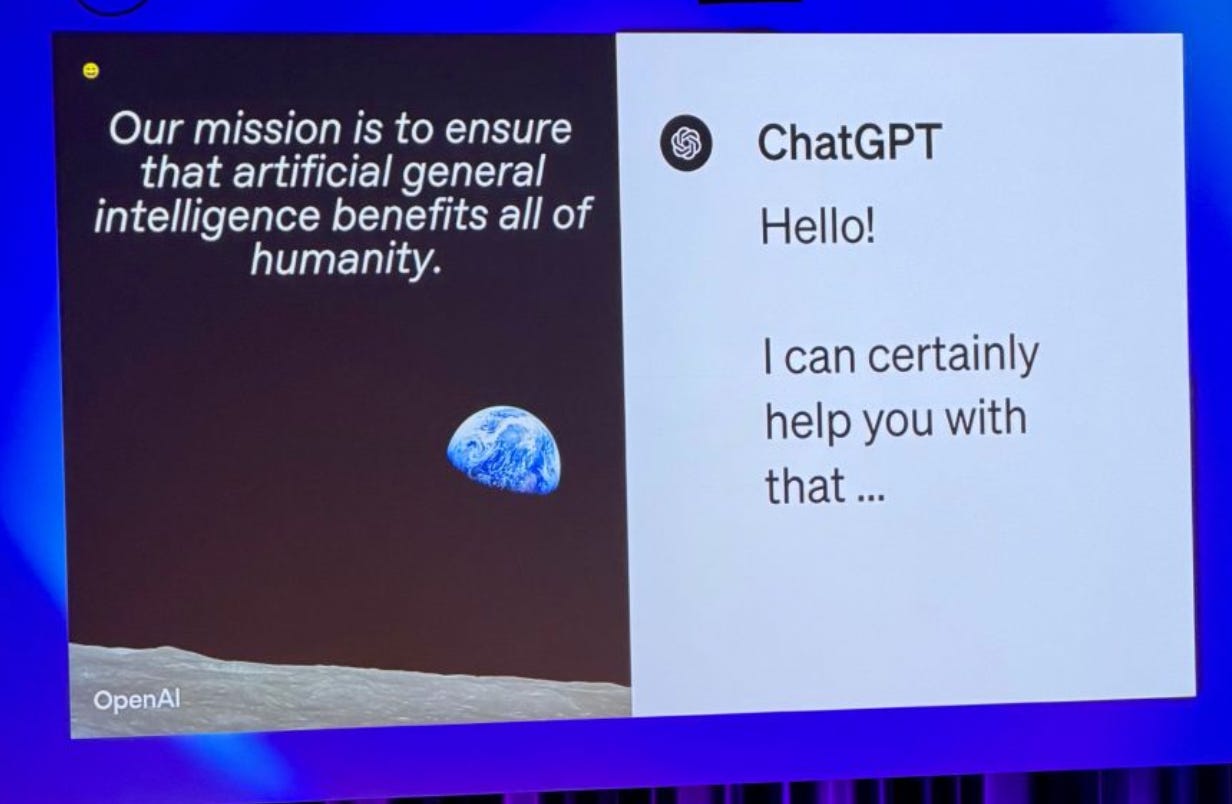
The cheery mood turned for a few beats as the presenter proudly proclaimed that everyone at OpenAI7 is now just “walking around with little microphones, steering agents through voice”. I concede voice mode is incredibly useful, even just as an assistive technology. But the delivery came off a bit more dystopian than intended.
Start-ups and Downs
An event with 1,500+ attendees has something to offer for everyone. So just like those trade conferences of years past, the usual suspects of masterclasses, startups, vendors, and related parties were all represented.
For the startup and exhibitor area, the vibe had shifted though. Thinking back more than 10 years to a time where I associated with a few startups through consulting and various accelerators, I was surprised at what a drastically different turn my casual chats took after the obligatory introductions. In the past, startups (including mine) had an identity problem: they put their product first. Now that may sound like the right and sensible thing to do, and there sure are cases where this is valid. But for the vast majority of startups that aim to scale, as in get investments on the basis of value multipliers, buyers and funds look at the team first, then the vision, and the product last. The product may change ten times before the first hockey stick appears on any graph. But if the team doesn’t work well together, if they do not have a vision that is easy to grasp and easier still to sell, they are bound to fail.
So it was interesting to see that vision and process had become the selling point. Nearly all conversations went something like this:
“Hi, what do you do?”
“We’re company A, we’ve been providing product B for a few years.”
“Cool, what do you hope to get out of today?”
“AI has been a big change for us. We spend most of our time now sharing our expertise to set up customers with the right process to scale B. We’re looking for clients, but also ways to make B work better with customer AI workflows”
The disruption from AI didn’t lead to the death of the startup, but it serves as a ruthless forcing function: can customers benefit from your expertise, your team, your vision beyond the pixels on screen and code in your repo? If not, you won’t survive.
I see the same in my own work: customers have stopped demanding a golden path that works for them, and have started to ask two questions:
Give us best practices - how have similar customers been able to successfully get value from this feature?
Great UI, but how will this fit into our agent workflows?
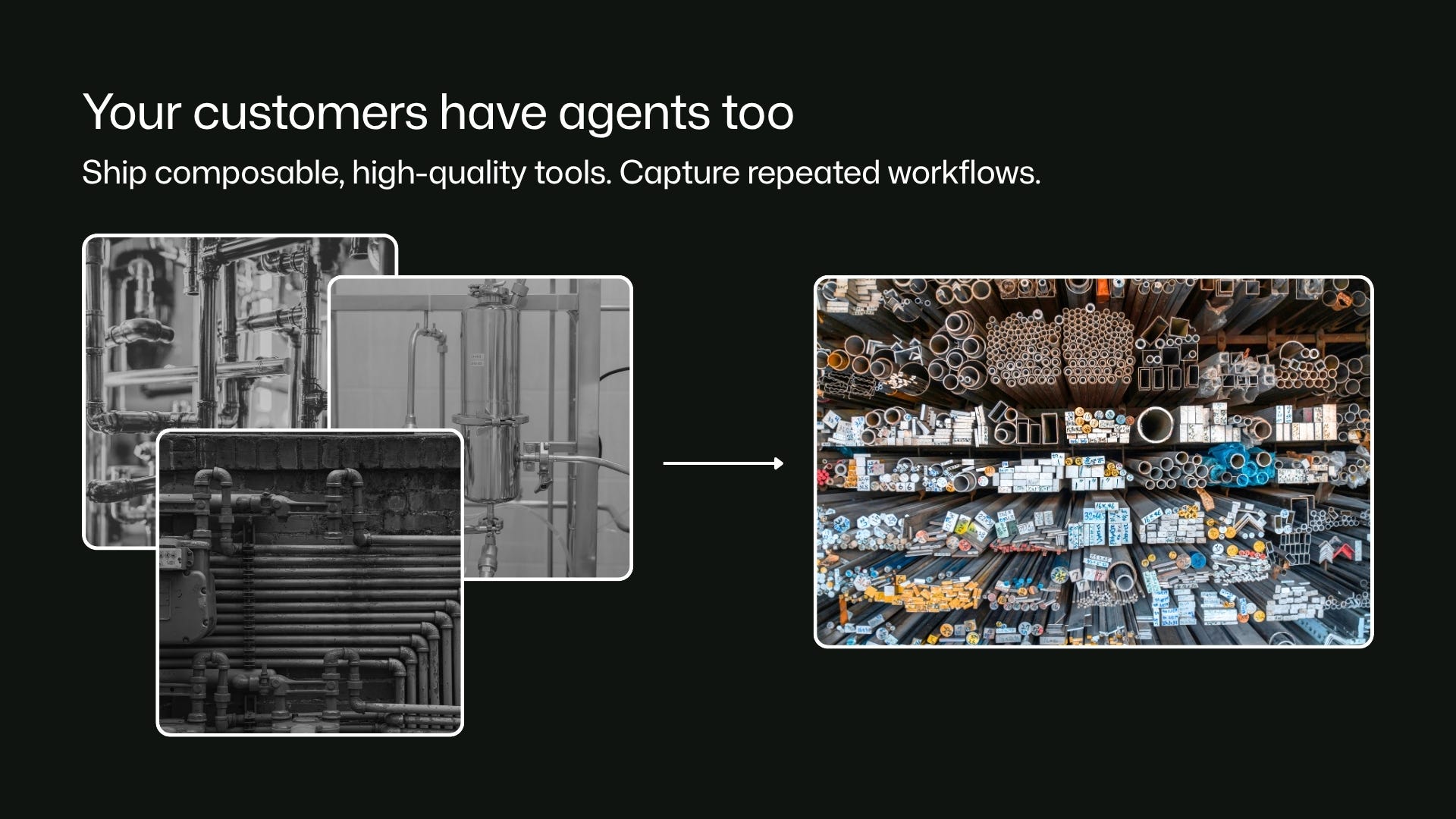
Your customers have agents, too. Even if it’s the most basic variant, like shadow IT usage of ChatGPT, the AI is coming from inside the house. Products need to adapt, provide fewer locked-in workflows and more composable tools.
Brass Silicon Tacks
The most valuable takeaways for me personally, but I reckon for the local industry in particular, were the sessions on physical AI. Not so much the countless sessions on humanoid or industrial robotics - which are interesting but all seemed to agree so much that content started to repeat - but the foundational ingredients. Infineon’s session on applied AI within all semiconductor foundry steps was genuinely interesting and exposed the recursive complexity of the silicon supply chain. Panel discussions on regional investments, changes in higher education to help train future talent, and debates about timelines for disruptions added helpful color. Silicon valley is hyper-focused on the abstract applications of AI (and I’m guilty of this, too), only now waking up to AI-powered hardware improvements. But those are still guided by bolting them onto the chat and agent operating model.
In the physical realm, world models, simulation, and mass scaling of edge compute are the real next targets of AI disruption. No session was as straight forward about this as NVIDIA’s: the next billion GPUs aren’t for LLMs, they’re for physical AI. Three tiers of AI compute will, according to NVIDIA, put more AI silicon in use than is deployed at this time for LLM inference. First, training and post-training of world and physical prediction models in high-density AI factories. Then, customers using sovereign AI compute to apply and optimize the models for their physical infrastructure - the processes, the materials, the robotics. And finally, edge AI compute in the form of Thor, Jetson and co powering the real systems deployed in the physical factory, products, and OEM solutions.
There was as much discussion about Cosmos at this event as there was about GPT, an interesting development that points to an area of tremendous potential growth with clear value. But also one that, I think, could benefit from a larger set of diverse players beyond the usual suspects.
My Talk
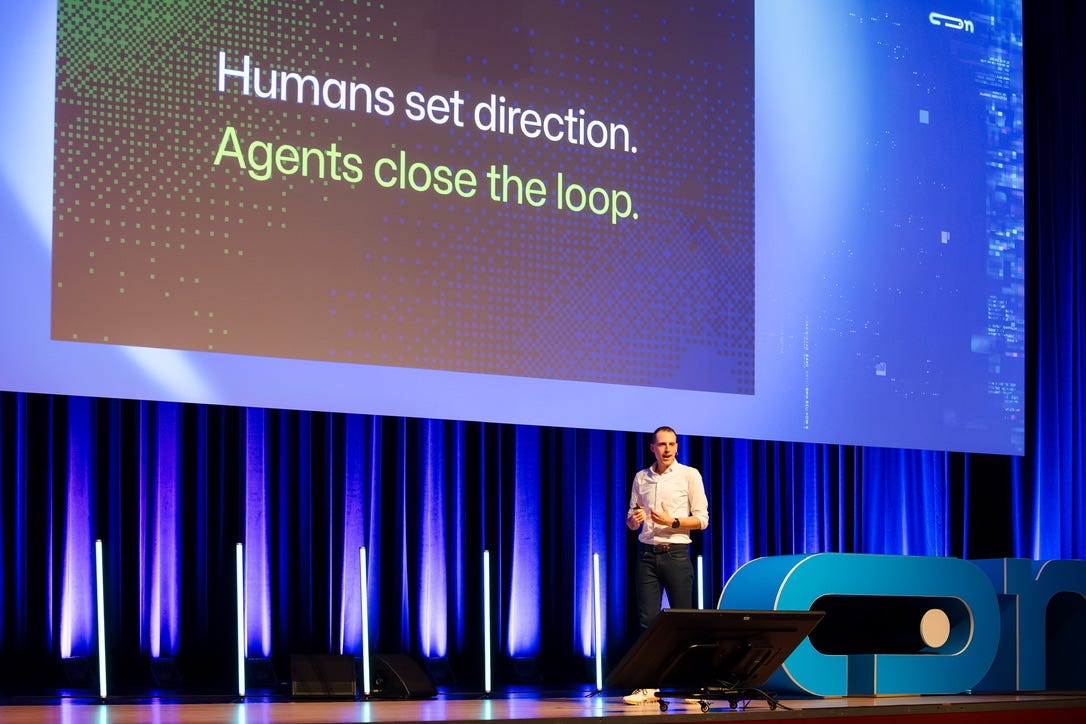
My talk, video available at the top of this post, was focused on two themes underlying my work at the moment:
GitHub is scaling. I know we sound like a broken record, but it’s easy to underestimate the insane stress this scale puts on humans and tech, and how much time has to be invested to catch up. I like to call this faster than realtime scaling. There are physical limits, starting with limited storage and compute availability to put into data centers, all the way to the cognitive capacity of an organization, that determine how fast a system can really scale. The limit is reached when no additional money or attention can be spend to further expedite this process. This is hard to observe from the outside - in the users’ reference frame everything in the world is moving and scaling like never before. Yet there isn’t a second going by without immense investment and work towards scaling, availability, and developer happiness. All this essentially demands effective AI application - there’s no use in tokenmaxxing, we actually need to deliver.
Second, this pressure to deliver isn’t unique to us, it also affects our customers, and open-source developers. The bottlenecks for AI adoption are no longer lack of choice, or lack of knowledge, or the tech itself. It’s the organization, the barriers to sharing information, and the potentially disastrous traps everyone can fall into while using AI.
The majority of the talk highlights the latter - the traps, the challenges, the problems. At the end, I do my best to give you homework, the first steps you can apply to counter these. But the most important thing to emphasize is honing and applying your human taste and craft.
If you work in tech, don’t let AI happen to you, make sure it happens with you.
***
As always, for any questions, send me an email or comment below. All inquiries are treated as confidential by default.
September 14 & 15, 2026
1B EUR of which was provided by government grants
Whatever did these people actually do with the hundreds of free, branded ballpoint pens they collected?
Who knows - it might be real …
German word of the day: Torschlusspanik
When the closing speaker called out the total lack of truly international but German-founded tech companies beyond SAP, there wasn’t so much as a murmur of disagreement in the packed audience. It doesn’t help that the only other well-known player turned out to be a scam. In 2015, many of the companies in attendance would have presented themselves as international, but none of them actually believed it.
Munich